
Still Trying
If the world would TURN IT OFF, maybe I could

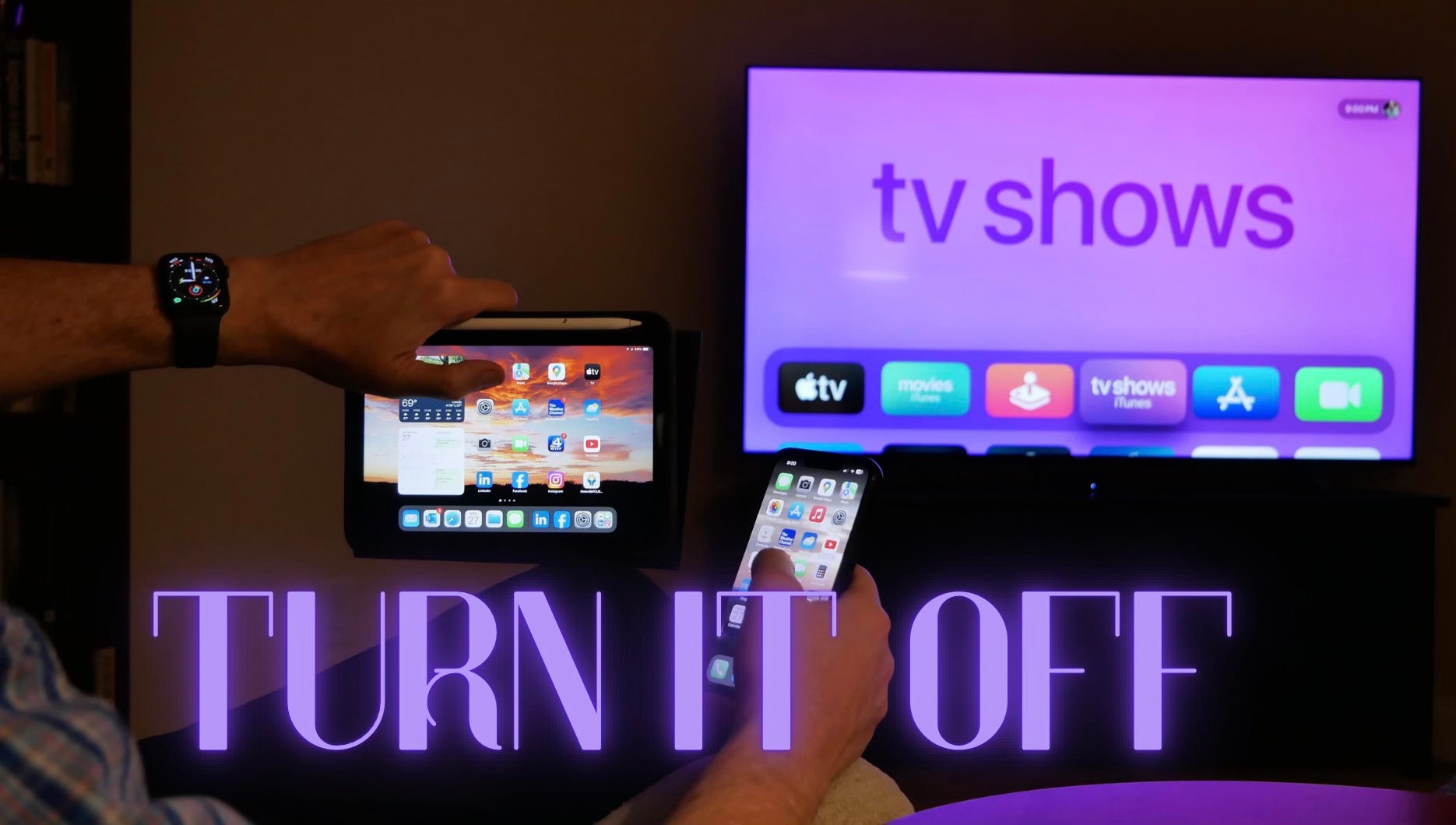
We haven’t shared a screen update for a while - for a good reason.
It hasn’t been going that well.
Oh, we’re keeping social media at bay, mostly, but spikes follow the news cycle and unfortunately the world keeps spinning - war, conflict, politics - you name it, there’s always an excuse.
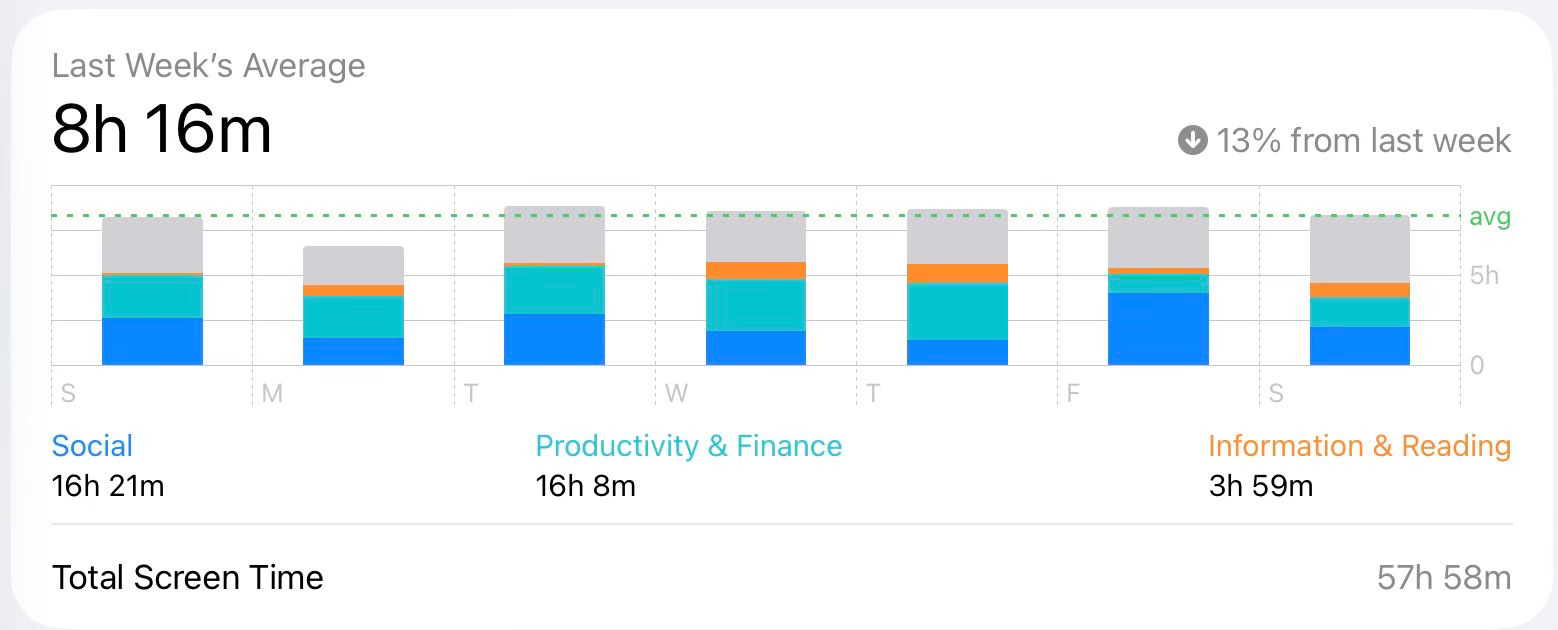
Total screen time was about where it’s been since we started this Substack, with an average of 8 hours a days fairly evenly divided between social media and “productivity.”
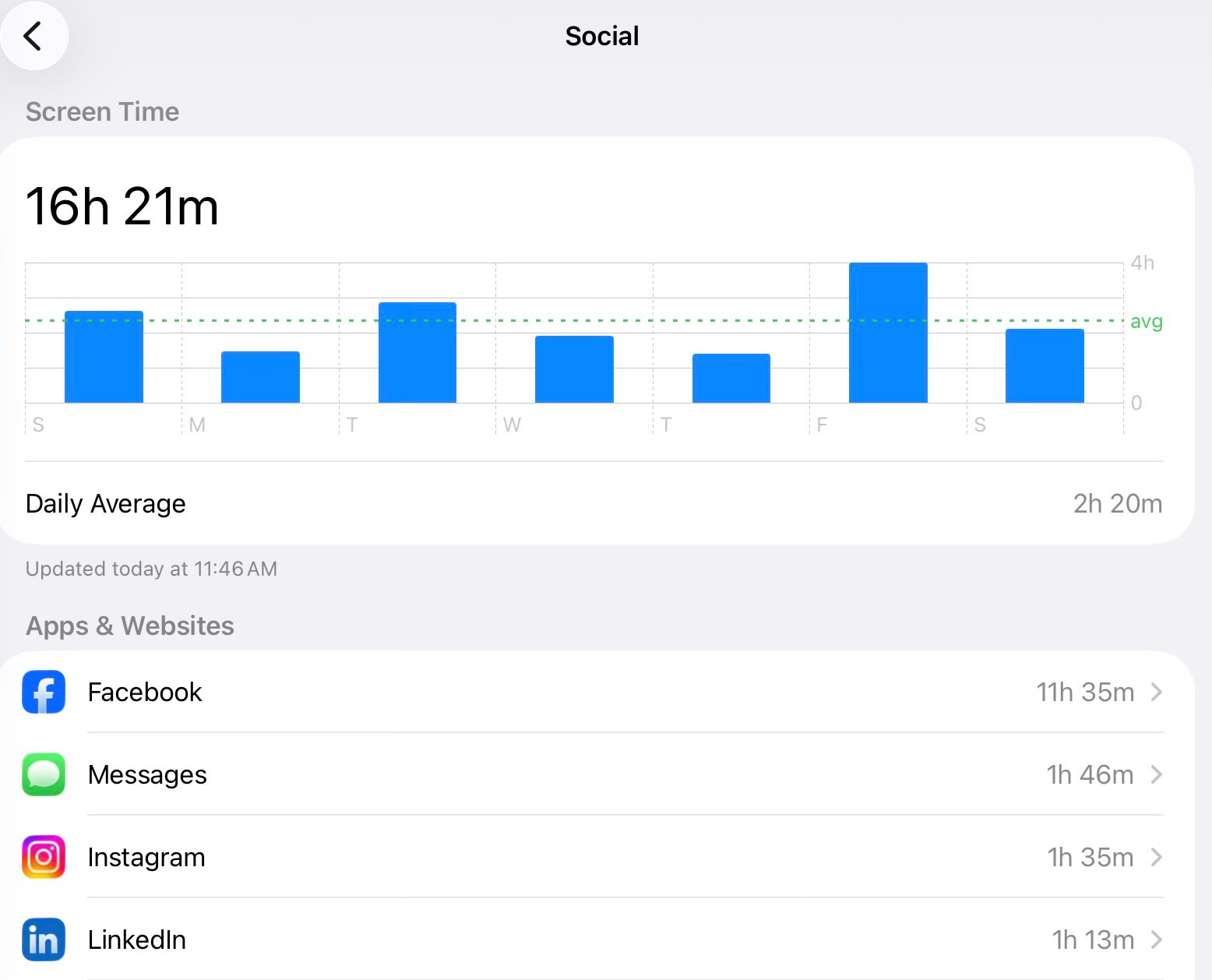
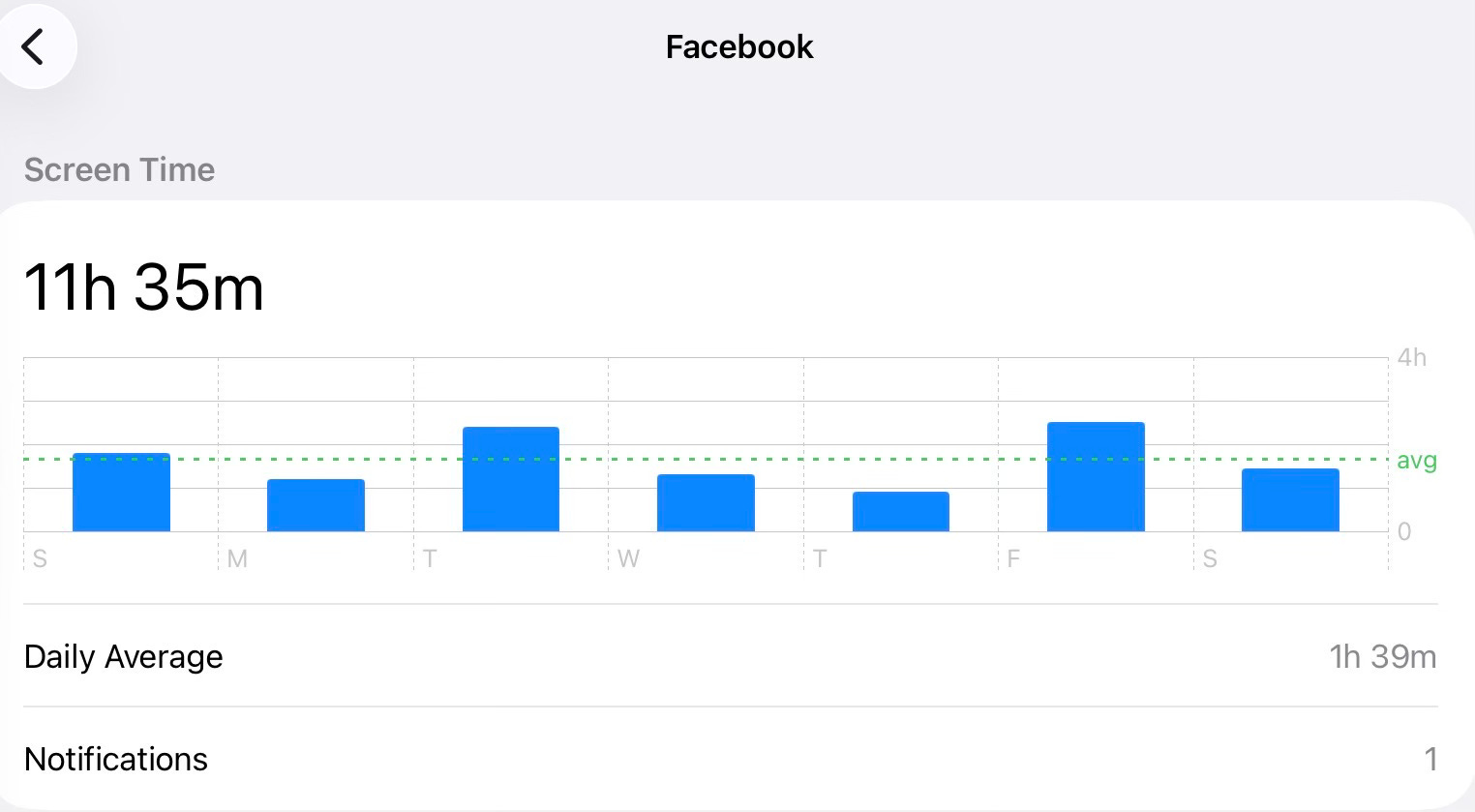
Most of the social activity comes from - you guessed it - Facebook, our nemesis and sub-one hour target. We’re not there yet.
I must also confess another overage that doesn’t show up - Threads.
Regular readers know we’ve focused on criticism on the commentary platforms, but even though Threads is off my phone as an app, the Threads website showed up under Productivity minutes and they were definitely - not productive.
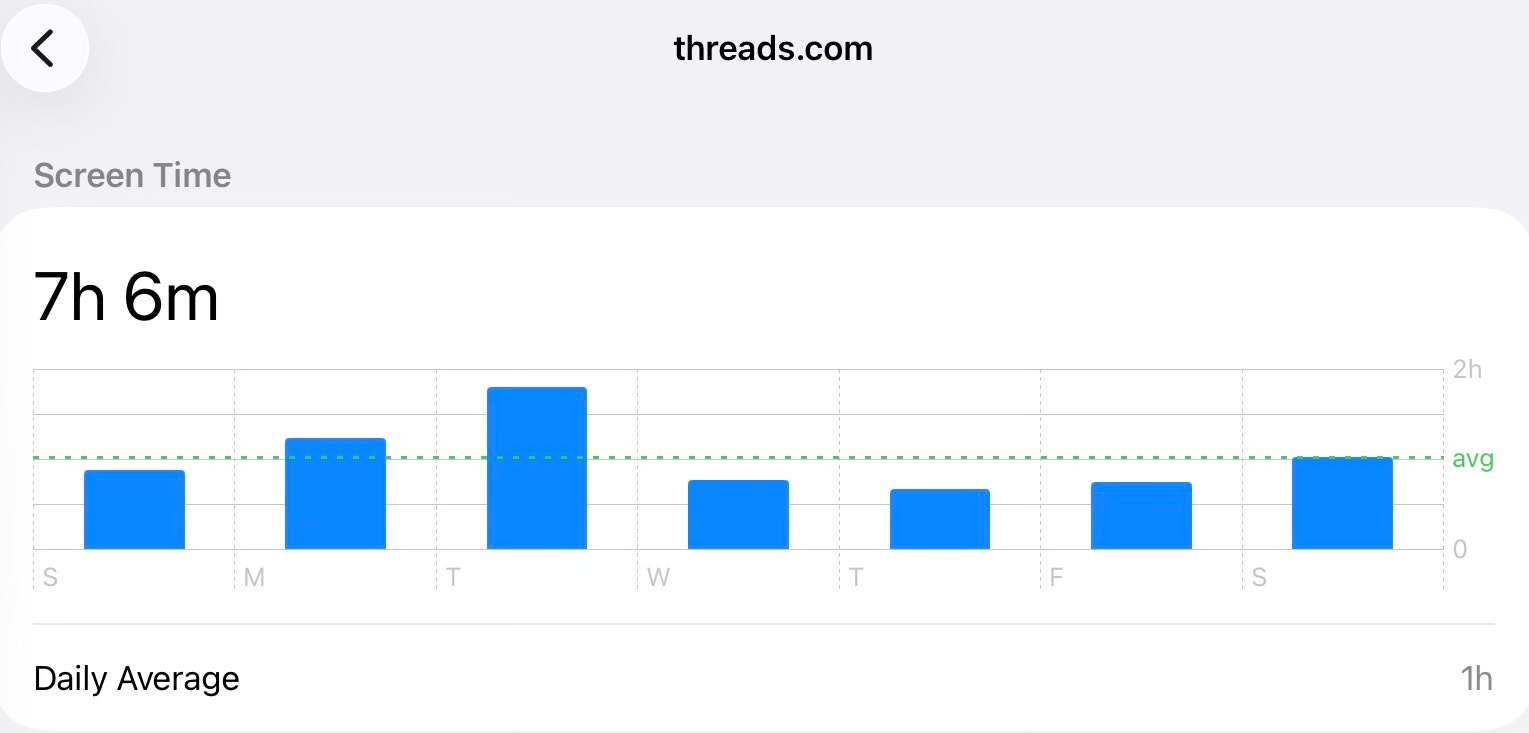
TURNING it OFF will take more than the occasional dead week in the news, which never seems to happen these days. It will take a determined effort to not go there and this is why we post these updates - to keep ourselves accountable on the journey.
Nexstar Network
Since we’ve written here about the Nexstar-Tegna merger and offered minimal concern for how it might impact news coverage, this item about a Nexstar decision to limit network content is at least a yellow flag.
Most local TV stations are network affiliates - not owned stations. While that means they carry ABC, NBC, CBS or FOX programming it also means they have access to video news and information resources from their affiliated network.
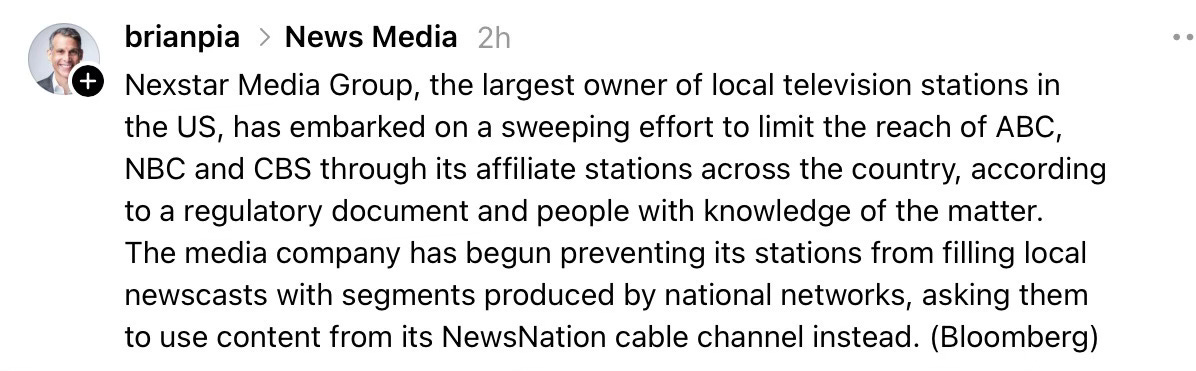
As a former newscast producer, I can tell you the stations really depend on those network feeds to fill their shows. Very young producers are often the primary writers, content editors and gatekeepers on hours and hours of news - sometimes at obscure times like 5 a.m. when there are very few local resources in the mix.
I don’t know if Nexstar’s decision to limit stations to its own feed is primarily a business decision or political, but the news you see in many dayparts will now have one less resource in the well and that may mean narrower perspectives on the news.
Tweets a’ Changin’
Two items this week reminded me again how much the media environment has changed in my lifetime in ways that impact what you see and read.
The first is about the nature of journalism itself and the public’s expectations. ESPN reporter Holly Rowe posted an X tweet criticizing the University of Tennessee’s athletic director in light of the entire roster of the Lady Vols basketball team transferring out at the end of the season.
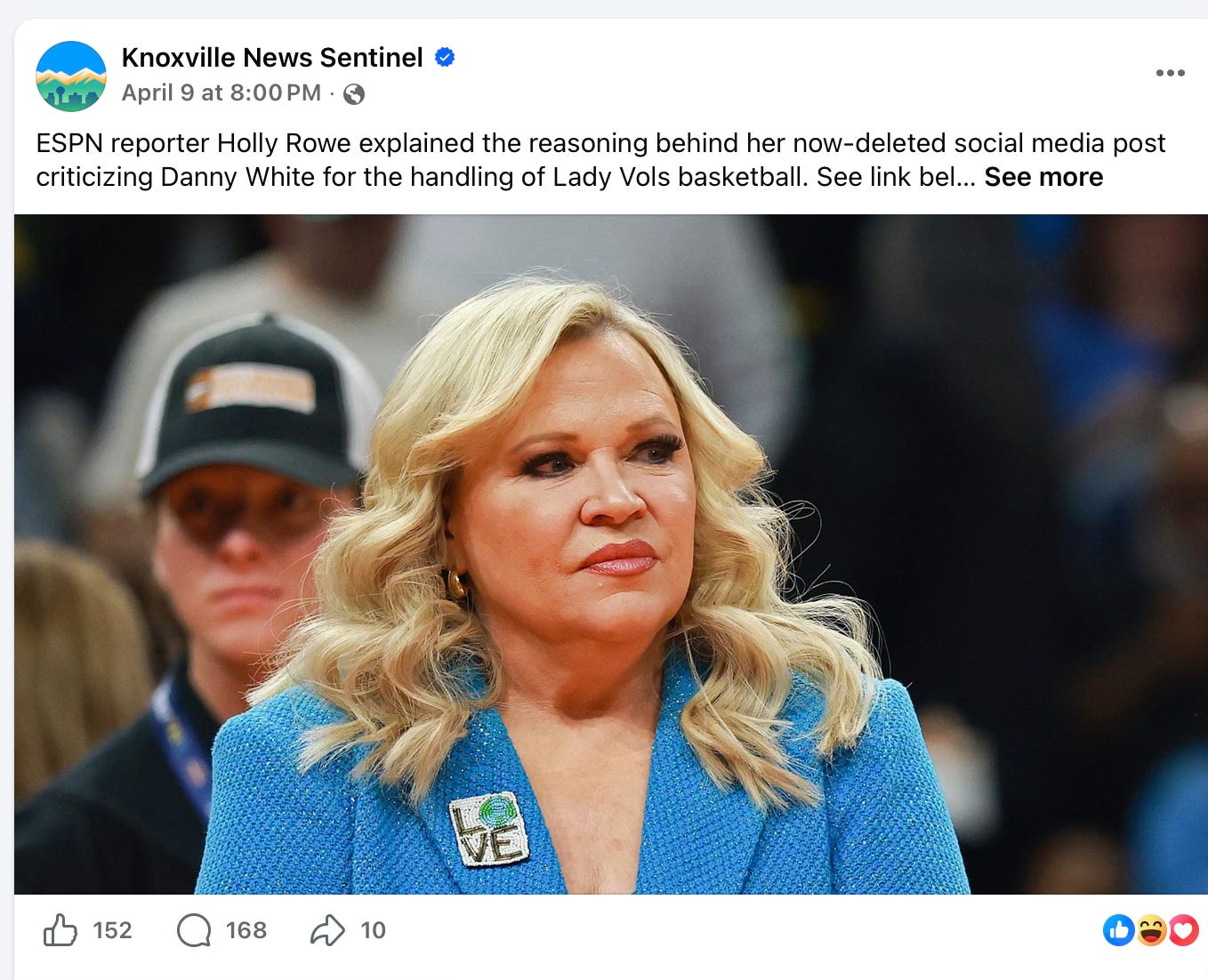
I won’t debate the substance of her statement here except to disclose - I am a Tennessee alum, a Lady Vols fan and a fan of women’s basketball in general.
I weighed in on some comment threads - mostly on Facebook - not on the news itself but about the propriety of Rowe’s tweet.
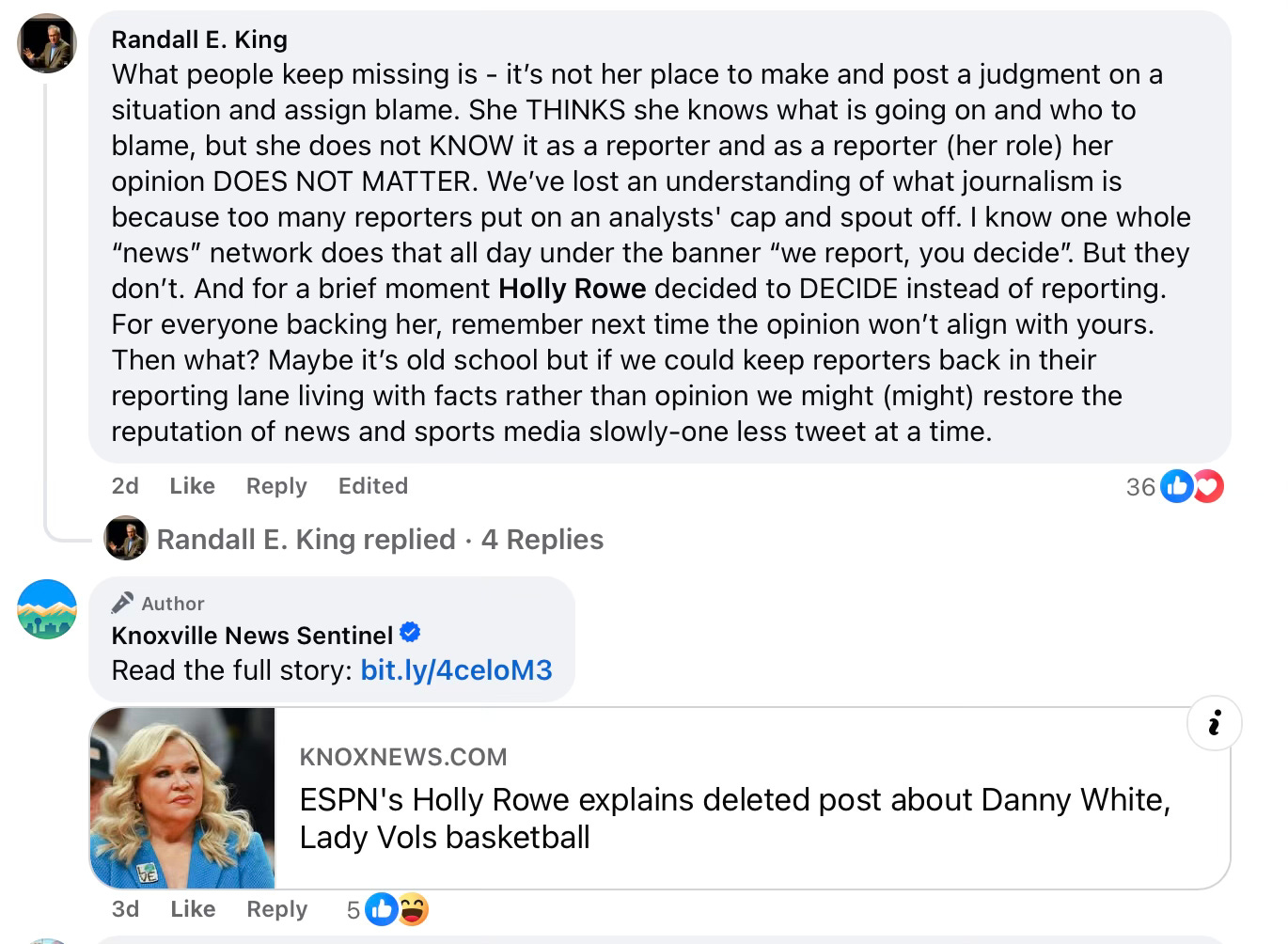
My point then, and now, is not that Holly Rowe can’t have an opinion, but IF she is primarily a reporter her opinion should stay private. I was surprised by the response of some (not having my views called “stupid” - on commentary spaces we just call that, Monday)
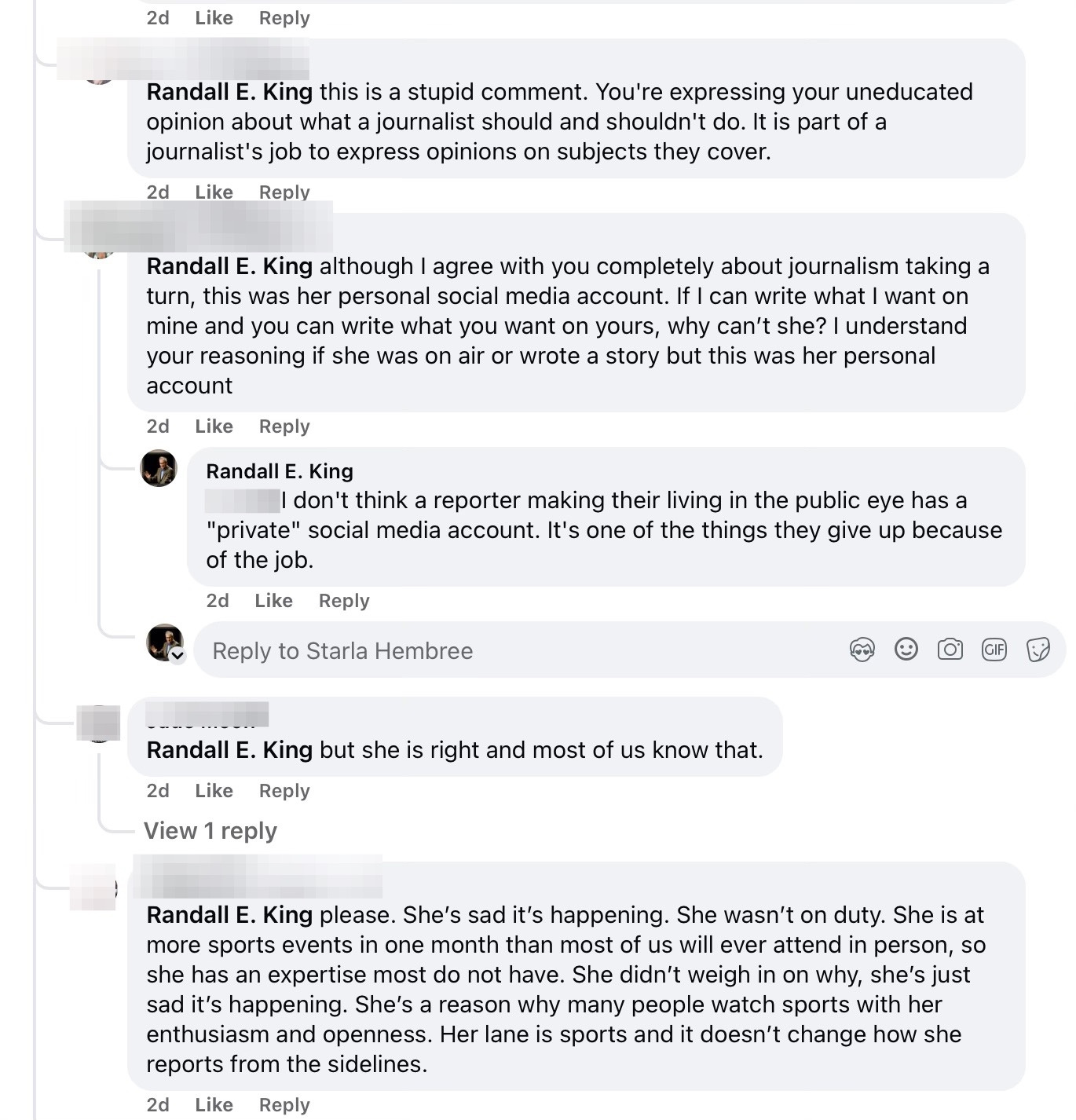
No, I was floored by how many people said giving her opinion is exactly her job. I think this illustrates how thoroughly news media have ruined the perception of journalism with commentary shows, social media and analysis masquerading as news coverage.
When journalists lament their low public esteem, I don’t always have sympathy after events like this. You blurred the line by tweeting what you think vs. what you can report, verify and attribute. It will take decades to rebuild that wall the industry needs between reporting and opinion.
Streaming Splash Down
The other media’s a changing’ item that struck me this week is a great positive for the country - and maybe in the long run for media too.
Like many Americans, I celebrated the successful return of Artemis II last week, although I wasn’t really keeping up with the mission like I should. A family text reminded me to watch it live and I did my usual channel scanning to see if the broadcast networks were cutting in to regular programming.
Indeed they were and I watched. But after the splashdown, a curious thing happened. Waiting. Inactivity. Procedure as the Navy recovered the crew properly and flew them out.
These were all parts of the normal NASA endgame, but few people remember the 70’s and attention spans are short. The broadcast networks went back to regular programming and encouraged people to find their streaming channels.
And what did they get then?
Talk…and waiting…and talk…and more talk.
This is the way continuous news coverage has been handled at least since the Kennedy assassination. You fill the time somehow but never allow - gasp - silence (dead air.)
People didn’t have alternatives in 1963.
Now, they have YouTube.
I discovered that not only was a commercial-free NASA stream available (which was feeding most of the video to the other networks), but it was way less annoying than listening to anchors and experts fill the time while nothing new was going on.
And you know what NASA did when there was nothing to say?
NASA said nothing.
As I am posting this link, the official NASA broadcast on YouTube has over 22 million views. Something is going on and the traditional networks better take notice.
My short post on Threads pointed it out and got the biggest response I’ve ever had on that platform - over 5000 likes.
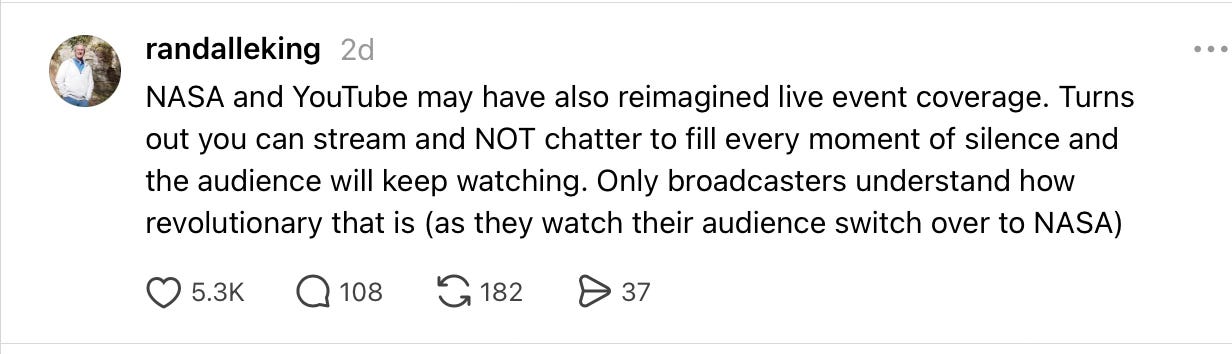
Breaking coverage was kind of the last franchise cable and broadcast news had going for it and when it truly matters, I think those news teams will continue to find an audience.
But for any number of other news events that are kind of “turn on, leave on,” while folks try to multi-task, the unfiltered live stream may be the new normal and if the traditional folks don’t figure out how to migrate their audiences to that (along with monetizing it) YouTube may steal even more eyeballs next time.
But, Look Up
Still on the news itself, let’s be positive and say when millions are looking to the stars again at what we can accomplish - together - it’s not a bad thing for our nation and our world.
I barely remember the black and white images of Apollo 11. I think I was 6, but I do remember the positive feelings we all had of witnessing that history.
Later on in school, I learned how fractured the late 60’s were - war, assassinations, race riots, protests - and yet WE put humans on the moon.
Our political, economic and media worlds need a unifying hope right now and once again the answer might be to look up.
In looking up, maybe we will find out all over again, that hope won’t come from Washington, or Hollywood but in a God who created us in His image to do great things:
I lift up my eyes to the mountains—
where does my help come from?
My help comes from the Lord,
the Maker of heaven and earth.
Until He returns, we have work to do to make this world better. Let’s know what to turn on and to TURN OFF as we look for meaning through His strength.
In DFW we had a highly rated anchor who developed a weekly “unhinged” segment at the end of his sportscast. He had decades in a tier 1 market and had the earned capital to pull it off, but he did cross the journalism line. I admire your optimism that we possibly can.
Also, I was thrilled to see co-workers the age of my children become enthralled with the Artemis mission. America can coalesce around a single goal or moment and we desperately needed it.
I encourage you to keep writing!