
The Conclusion Illusion
What did you see when you saw what you saw?

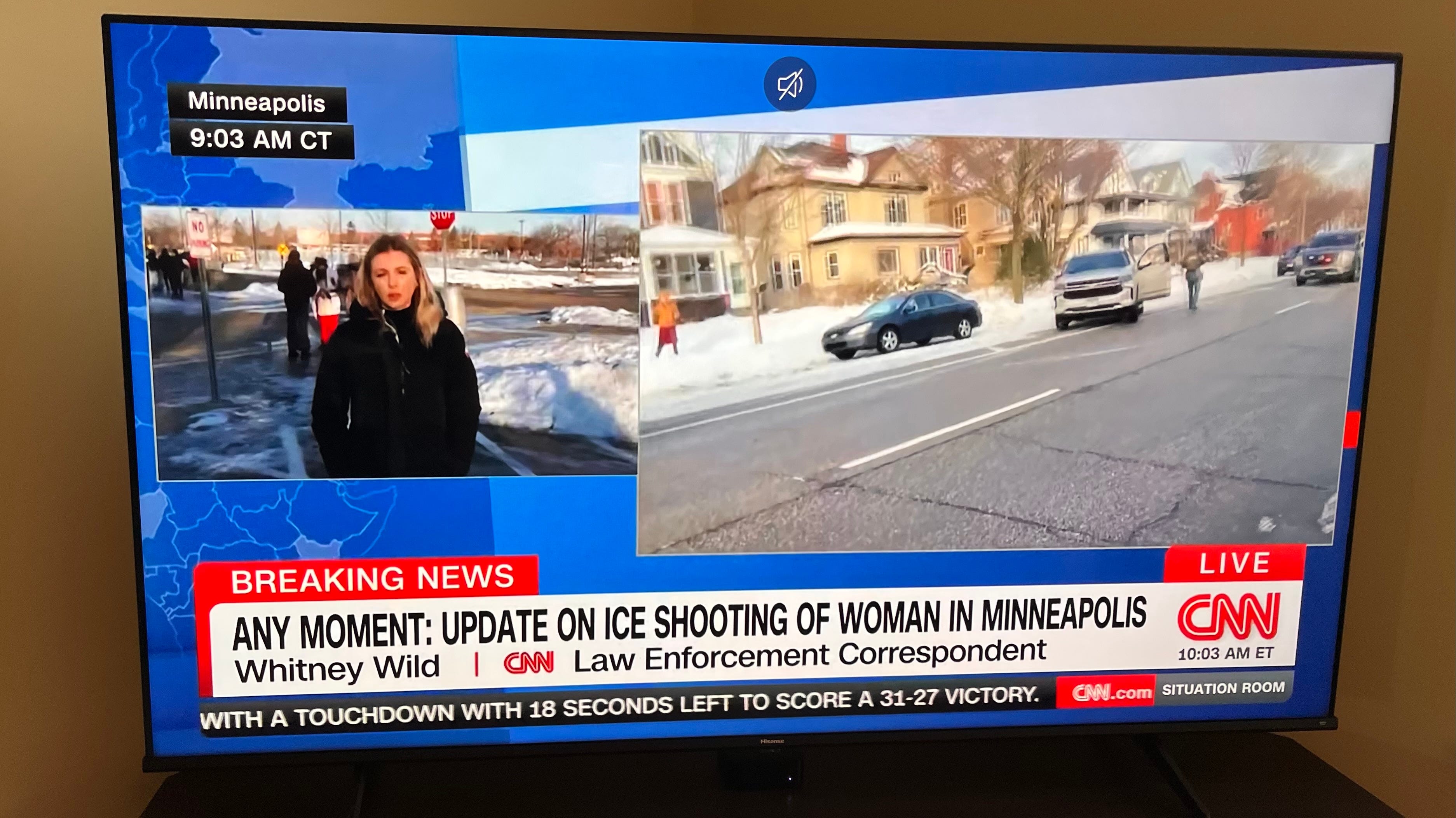
Unless you really were able to TURN IT OFF to start the new year, you are likely aware of the tragedy involving an Immigration and Customs Enforcement (ICE) officer and private citizen in Minneapolis.
I share the video here from a mainstream news organization for illustrative purposes and not necessarily for the commentary that accompanies it. I know there are other angles and more graphic versions floating around online, but you can find those on your own or turn off the sound on this one.
I’m going to try to avoid the politics of the moment or potential criminal implications of this event and instead ask some media literacy questions.
What did you see when you saw what you think you saw?
I’m not being facetious here. Like the Rodney King incident in 1991, these video moments are a kind of Rorschach test of confirmation bias, pre-judgment, and the illusion that we must have conclusions every time something awful happens before our “eyes.”
King’s beating was among the first and most well-known citizen video incidents of my lifetime. Remember when we were all fairly certain we saw what we saw.? Then months later a jury - with context, more video and eyewitness testimony - apparently saw it differently and acquitted most of the officers of criminal charges.
Beyond citizen video, the incident energized another trend in the 90’s - continuous live cable TV-news coverage and “analysis” that inevitably leads to speculation and conclusions about cause, blame and guilt. Media talking heads will say “we don’t want to speculate,” but the beast of continuous coverage must be fed and eventually will be satisfied with speculation.
Of course, today that beast is fed early and often by all of us. We don’t have to wait for journalists and analysts to tell us what happened and who is to blame because we’ve already turned judge and jury on our own media.
Free-wheeling experts on X, Facebook comments and the rest were way ahead of the legal curve in Minneapolis and - like armchair football coaches - they knew exactly what happened and why. I won’t share any screenshots in this space, but you can still find them everywhere.
Frankly - they’re awful.
A woman is dead. Some people have no shred of humanity online.
The only thing more depressing than public officials rushing to judgement are the conclusions many of our fellow citizens quickly reach and post - from both political “sides.” I want to think only a few commenters are the crazies, but I fear they are not.
I want to illustrate how far we’ve slid with a wayback story from my own career. As a television reporter in Florence, SC in the mid-80’s I got tapped one morning to rush downtown for a hastily-called press conference by the police chief.
It was so urgent that my news director gave me the keys to the live truck - the only station vehicle available that day - and I promptly broke the microwave mast trying to drive it out of the station’s garage. It was a comical beginning to a very serious story.
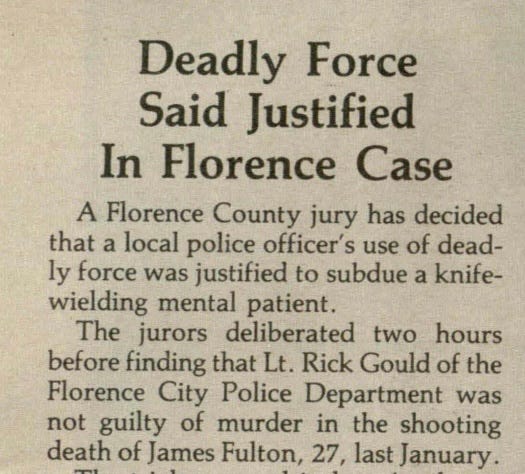
Florence police Lieutenant Rick Gould was involved in an overnight shooting incident. White officer, Black suspect - now deceased. The chief told us that much in his opening statement with a few more details on time and place and then announced routine administrative leave for officer Gould.
Then he uttered the second least-favorite phrase any reporter wants to hear (after “no comment.”) The shooting was “under investigation,” and there would be no more statements from police.
He meant it.
But plenty of other people had something to say. Due to the racial component, African-American communities responded with news conferences, prayer vigils, rallies and marches. They concluded the suspect had only threatened the officer with a “butter knife” and then he shot out of racial prejudice.
And my TV station covered it all, with restraint, but never with “both sides” equally represented. To some, this was not “fair and balanced” - and how could it be? The police would not talk and the other “side” would not stop talking.
I was not the only reporter covering the fallout, but I was the lead and it got back to me months later that Gould thought I was personally out to get him. We never talked about it one-on-one, but it hurt that someone thought I had an agenda when, frankly, I was a just young reporter who had the story fall in my lap. I was trying to figure out how to do my job with the limited facts in front of me.
After the initial rush of protest, we didn’t really cover the story further until the trial several months later. When the details came out in court, Officer Gould was acquitted by a jury. The conflict was complicated, it was dark and the so-called “butter knife” was huge. Imagine a large blade in the hands of a very large man coming towards you - in the dark.
The deceased - also a mental patient - never stopped advancing and finally Gould followed his training and had to subdue the threat with his service weapon.
Gould was not guilty - and could finally talk. I put his tearful soundbite in my story.
There are many things about that and other stories in my early reporter years I would do better now with the benefit of age and experience.
But this I know: We didn’t speculate. We didn’t insert our opinions. We stuck to facts and attributable comments (usually on-camera). In other words, we did journalism at WPDE-TV in Florence, SC, to the best of our abilities.
I will grant it’s not 1986 and we were not 24 hour cable. We had news at 6 and 11, no website and - most importantly - no social media on which our content lived and others commented.
We also had no citizen video.
This is the reality of today - for Minneapolis, Portland and every “breaking news” tragedy that will happen in the months ahead.
These limitations on traditional media were actually guard rails - for us and the public. They were not perfect and people still jumped to conclusions, but at least in the media sphere we were constrained to wait for the investigation to play out, facts to emerge in a proper context and justice pros to do their work without the incessant clamor of online experts and influencer wannabes.
Not today.
Social accounts and video give us the “seeing is believing” conclusion illusion. It’s arguably better with video than without, but every camera has an actual point of view. Even when we see it with our own eyes via video, we cannot set aside our preconceived notions.
We interpret what we see through our mental filters. That’s why millions could watch the same clip from Minneapolis and “see” it differently. That’s also why a court of law tries to get as many “views” of an incident as possible.
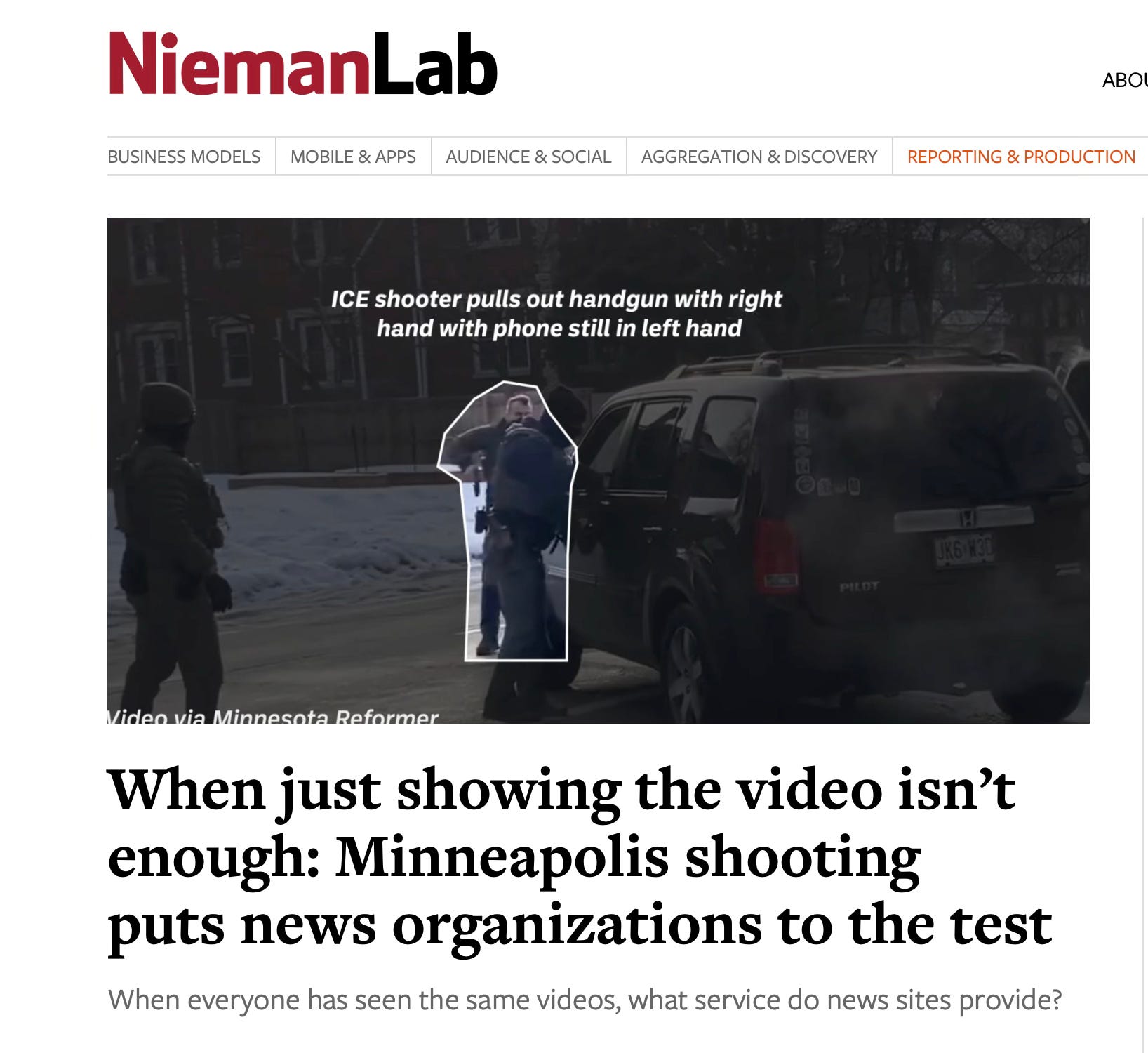
Truth - or the best available version of it - is probably somewhere in the middle between images and eyewitnesses. It is not perfect, but it’s better than most of us do with 15 seconds on X… - “I know what I saw.”
Certainty is easy, when there are no stakes.
I know we can’t legally put this genie back in the bottle and I can’t imagine any kind of top-down, government regulation that will fix our irrational rushes to judgment. But I do have a few suggestions for the media and governmental leaders involved - for what it’s worth from an old Comm Prof with a blog (probably not much.):
Journalists - Quell the Commentary.
I have no illusions commentary will ever go away from live coverage. The beast will be fed, but cable networks and local stations can limit themselves and their guests. To be fair, reporters on the ground and most of the journalist-anchors I viewed this week stuck with the facts. When they turned to commentary or analysis, it was often from law enforcement experts who stayed within the safer spaces of analysis.
My problem was the panel shows, non-journalist “hosts” and influencers who - naturally - are more interesting, less-restrained and make their living on certainty. Mainstream media can keep these people off the air and they should, no matter what is happening on social. In fact, I think the only hope for the “mainstream,” going forward, is to re-center reporting over commentary. I’m not holding my breath.
Politicians - Shut Up and let the Investigation Proceed
This is a both sides thing, but I wish our leaders would simply do like the Florence police chief did years ago - let “under investigation,” be enough. Our politics are so divided now and the leaders are so quick to try to “control the narrative,” that they get way ahead of the legal system and inflame their tribes.
I know I am idealistic on this point, that the system is broken and the public must be stirred (as if they aren’t worked up enough already) but “no comment, under investigation” worked for years, slowly, frustratingly but still better than reaching conclusions based on populist passions. The people probably can’t be silenced, but leaders can self-censor. It’s called restraint and it’s called leadership. We need some.
Social Media - Grown Ups be Grown Ups
As we learned to some detriment during COVID, social media companies DO regulate content and the most extreme comments or offensive materials gets taken down. I’m not going to argue the merits of this here because I know it’s a loaded proposition. But while we probably can’t expect Twitter (X) or Meta or any of the others to restrict comments that are conclusive, speculative or libelous (yes, it happens, thousands of times every day), the mainstream media sites that purport to be better than the rest CAN turn commenting off on their social pages and websites. I know they measure and thrive on that “engagement” but there is a cost.
As I have said, I think the only future for traditional media hanging in there is to set new standards for journalism and live by them. No matter how responsible their reporting and posting may be, it is undermined - continuously - by the comment threads that people read and trollers seek. Yes, it’s a small step and potentially elitist, but any slowdown in the commentariat would make for a healthier social media environment and give actual journalism a safer space to work.
The Rest of US - Breathe and TURN IT OFF
This is the hardest part for those of us who find it hard to look away from the train wreck. I will confess to jumping back in to the commentary sphere this week and wading through the muck. Lots of heat, very little light and endless judgment.
My rational understanding of what happenned in Minneapolis was not helped by social media - only my emotions aroused. And that is the point of most “engagement.” The apps and algorithms give us more of what we want. Conflict and chaos = MORE.
So, is this Dr. Quixote tilting at windmills again?
Probably, but I still think our best hope is for us to TURN IT OFF and power down. Just this week, a good friend of mine left social media entirely and a colleague, Nathan A. Finn, posted about his decision to delete some of his accounts years ago.

Every week I hear more of these anecdotes and see more articles about people backing down, regulating themselves and turning off social and other media.
It’s not a movement, yet, but it is movement.
My closing application does not come from scripture but from the scripturally-grounded writings of the late pastor Tim Keller.
In his book on work and vocation, Every Good Endeavor, he writes of the journalist’s need to get answers - not just the what?, but the why? of every tragic event. This comes, Keller says, from the human need for a worldview - a “master narrative” of what ought to be:
“..a fundamental story about what human life in the world should be like, what has knocked if off balance and what can be done to make it right.” - Keller, Every Good Endeavor, p. 156.
Keller believes this leads journalists - in particular - to reach for conclusions:
“In most stories of crisis our modern, cause and effect worldview very quickly seeks someone or something to blame. After Hurricane Katrina hit New Orleans there was a finite period of time in which the basic news of devastation was reported. Very quickly the story devolved into attempts to cast blame…the need to to blame some aspect of creation is a human impulse-not a gospel one. The gospel tells us the fall results in brokenness in nature and in people. The real “story” of the gospel is the evidence of redemption and renewal.” - Keller, Every Good Endeavor, p. 170
The need for answers and - indeed - heroes and villains, is one we all share. If our media will not serve them up to us, apparently our leaders will - all while playing to our emotions and pandering to our sentiments (and future votes) on social.
I am not saying the pain is not real and a tragedy should be dismissed. I am saying we should hope and pray justice will prevail and slow judgment will be conclusive.
In the meantime, we don’t make this messed up world better by feeding on or adding to the chaos with speculation and conclusion when there are still legitimate mechanisms to get at the truth.
I guess I am telling myself to turn it off, power down and wait rather than buying the illusion that I know it because I’ve seen it and now must say it.
“Everyone should be quick to listen, slow to speak and slow to become angry, because human anger does not produce the righteousness that God desires.” - James 1:19-20, NIV.
Helpful, experienced advice.